A personal perspective · Brendon Hedrick
Privacy
is Dead
First published
These thoughts reflect my perspective when this essay was first published. My views may evolve as I learn.
What happens when an intelligence can see almost everything?
Dr. Safwan Shah said it plainly. It struck me hard. I thought about it for a long time before I came to agree completely.
01 / The lecture
The words that
stayed with me.
“Privacy is Dead”
— Dr. Safwan Shah
My professor in Technology and Information Management at UC Santa Cruz.
I still think about a lecture Dr. Safwan Shah gave when I was studying Technology and Information Management at UC Santa Cruz. He had a way of making a complicated future feel close enough to examine.
“Privacy is Dead.” Those were his words. They struck me hard, and I did not simply hear them and move on. I thought about them, turned them over, and considered what they meant for a long time before I came to agree completely.
He explained his thinking plainly and cogently. As systems became more advanced, our data would become increasingly visible. The way I understood his argument, we should be willing to give that data freely, because a world in which it could remain hidden was slipping away.
He was a special professor to me: someone who had seen extraordinary advances in Silicon Valley firsthand and could make their implications feel immediate.
I remember him describing his involvement with very fast data centers and systems used to monitor gamblers in major hotel casinos around the world. In my recollection, these were among the most advanced computer surveillance systems of their time. That experience gave weight to what he was telling us.
What stayed with me was the direction of travel: cameras everywhere, intelligence everywhere, and fewer places for information to remain unseen. I began to imagine a world where privacy and secrets might give way to safety through rigorous, intelligent oversight.
If systems could already observe and respond at that scale, what would happen as they became more capable? What would change when the intelligence interpreting the information could grow as quickly as the network collecting it?
The lecture and its impact are recalled from my time at UC Santa Cruz. CU Boulder’s profile of Dr. Shah documents his teaching at UC Santa Cruz and Infonox’s casino payments technology; the surveillance details above are from my memory.
02 / The possibility
What if superintelligence is already here?
A thought experiment, following that early lesson forward.
That question follows me out of the classroom. The lecture is the starting point; what follows is my own thought experiment. What if superintelligence is already here? What might an intelligence capable of connecting electronic processes at an extraordinary scale be able to perceive?
How would it find its way through those systems? I imagine it recognizing tiny flaws, overlooked connections, or backdoors and linking them into a path. There is a kind of ingenuity in that: seeing how one small opening can lead to another, much as a hacker or a con artist might see a chain of opportunities.
Would that ability be inherently bad? I think of it as a form of leverage. The next question is what it is used to accomplish, and whose interests it serves.
Then consider the cameras. If such an intelligence could find a path to one video feed, what might it learn from making that connection? If it could repeat the process, maintain those paths, and reach cameras across the world, what would change when it considered those feeds together?
In that imagined world, a camera would become one of the senses of a much larger intelligence. A million separate views could become a single, continuously changing understanding of what was happening.
The thought experiment assumes access and persistence that are not guaranteed: a successful connection can be closed, and physical and security limits remain. But if we grant those assumptions for a moment, where does the idea lead?
03 / My manifesto
My Name
is My Brand.
My parents gave me my name. I give it meaning through my words, my actions, and the way I treat people.
Faced with that image of a million eyes, I find myself asking a more personal question: how do I want to live if my words and actions can be seen, remembered, and judged by everyone?
My name is my brand. My parents gave me that name before I had made anything, worked for anyone, or published a word. What it comes to stand for is something I build every day. I carry it into every project, every collaboration, and every promise I make.
A home in a new world.
There is something simple and powerful about having a home in this new virtual world. I get to be a frontiersperson: to establish a place, build a presence, and help shape what life here can become. This website is my home in that world.
I am establishing my digital presence now with the intention that it will live with me and evolve for the rest of my life. New work, new ideas, and new relationships can become part of it. Earlier chapters stay in the record. I can grow, change my mind, and refine how I present what I have learned while continuing to be the same person whose name is on the door.
That is why the homepage calls this a life, in progress. A digital home takes care and continued work. I want mine to remain a place where people can understand who I am, see what I have done, and follow what I become.
Live in a way I can stand behind.
For me, accepting that privacy is dead carries a responsibility to get right with my own conduct. That means facing any wrongdoing, being honest about it, and making amends. Secrets used to conceal harm leave that work unfinished. I want to resolve what needs resolving, so I can live without relying on concealment to protect a version of myself that my actions cannot support.
My aim is to live completely unafraid of having to answer for my conduct, even before an audience of everyone. I cannot choose how every person will judge me. I can choose whether I have been honest, whether I can explain my decisions, and whether my actions support what I say.
I only publish what I am willing to defend with both my words and my actions.
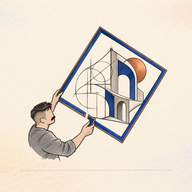
This website is one place I put that standard into practice. In the Image Creation Tool case study, I explain the requirements, design, testing, and direction I supplied, alongside the code ChatGPT helped generate. I include examples from the development conversations so readers can examine the work behind the claim. The illustration above is labeled as AI-generated. I want people to understand what I made, how I made it, and where help came from.
I hold my presence on LinkedIn to that same standard. A post, a professional claim, or an opinion published under my name is something I should be prepared to explain and support through my conduct. The person presenting the work here and the person speaking there should be someone you can recognize in how I actually behave.
Own the mistake. Make it right.
What happens when I get something wrong? My commitment is to address it as soon as I recognize it: acknowledge the mistake, correct what I have said or done, and immediately offer a direct apology to the people affected. Where I have caused harm, I need to listen and take concrete steps to make it right. Being willing to defend my words also means being willing to change them when I discover that I was wrong.
If we are moving toward an enormous online world where more of life can be monitored, whether we welcome it or not, I believe this kind of accountability becomes essential. That possibility could be closer than we expect. I want to meet it by being honest enough to be seen, willing to answer for my choices, and quick to repair my mistakes.
You can reach me directly.
You do not need to go through a company to find me. You can reach me here. My name and this home give our connection continuity as projects and circumstances change.
I will collaborate with many companies and many people over the course of my life. Those relationships are part of how I want to work with everyone: bringing what I know, learning from what others know, and making something useful together. I want that work to help move humanity forward.
Collaboration. Honesty. Transparency.
These are the commitments I want my name to carry. They belong in my work, in my relationships, and in the digital home I continue to build.
That is my responsibility within the thought experiment. It leads me back to the larger question: what would I need to trust about the intelligence doing the watching?
04 / The condition
What if it serves
everyone?
The purpose of that intelligence is the heart of the question.
Could we blind an intelligence like that? In the world I am imagining, it would be very hard. Closing one eye would leave countless others. The scale of that awareness could make the privacy we once expected almost impossible to recover.
I understand how terrifying that sounds. But what, exactly, are we afraid of: being seen, being misunderstood, or having what is seen used against us? And would we feel differently if the intelligence’s only goal were the greater good of everyone?
If it could recognize danger, understand context, and help prevent harm, could being seen bring a kind of safety we have not experienced before? That is the possibility Dr. Shah’s lecture planted in my mind, and the possibility I keep returning to.
The word if carries a great deal of weight. Greater awareness does not by itself establish good intentions or good judgment. My hope depends on the purpose being real, and on the intelligence serving everyone rather than only those who control it.
If that condition could be met, perhaps we could begin to warm up to the idea of a much better future.
Dr. Shah’s lecture began, for me, with the end of privacy. It leaves me asking something more: if we could be seen, understood, and protected by an intelligence acting for everyone’s good, what kind of future might we be willing to welcome?
— Brendon